


Your all-access pass to the people and events shaping Canada’s democracy
Results: 1 - 20 of 23
Legal Talk
The Courage of Their Convictions
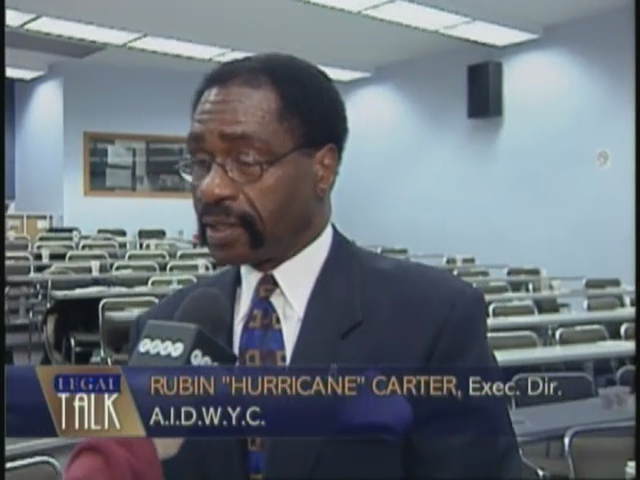
Host Tasha Kheiriddin describes a conference and concert held in Toronto, Ont., in support of the Association in Defence of the Wrongly Convicted (AIDWYC). Johnnie Cochran (American lawyer for clients such as O.J. Simpson) and Rubin “Hurricane” Carter (Ex
Law School / Environmental Law
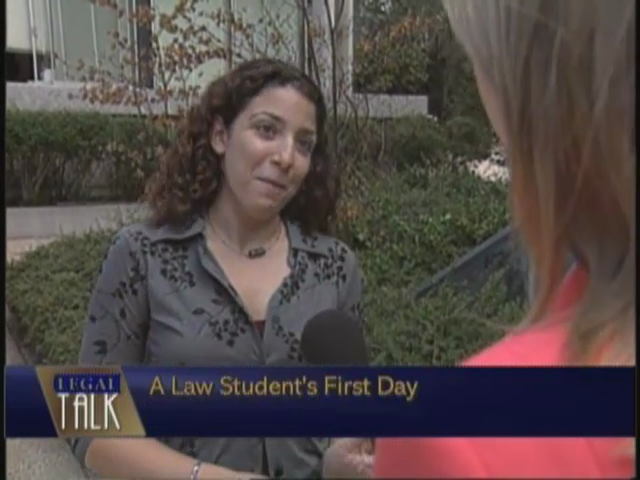
Host Tasha Kheiriddin looks at the experience of law students at the University of Toronto. She speaks with several students, including Sarah Armstrong, Katherine Gruspier, and Sana Halwani. She also talks to the Faculty of Law Dean Ronald J. Daniels, who explains misconceptions students have about law school. Later, Mark Mattson (counsel for Lake Ontario Keeper), Lynda Lukasik (vice-president of Friends of Red Hill Valley), Wally Rozenberg (supervisor for the Ontario Ministry of the Environment), and John Shaw (manager for the Great Lakes Sustainability Fund) discuss environmental law and its implications.
Supreme Court 2002–2003: The Year in Review
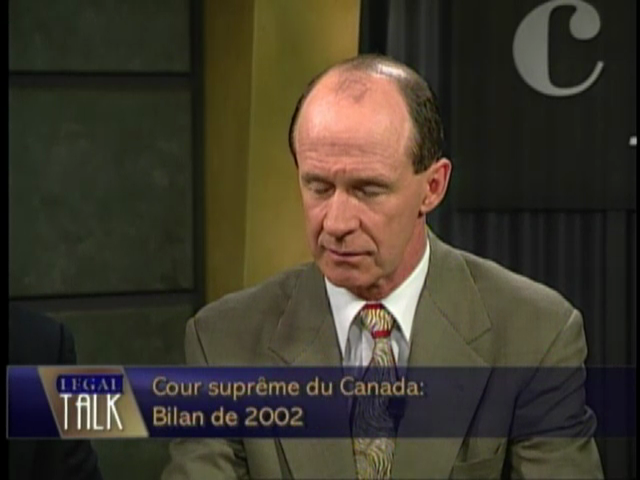
Host Tasha Kheiriddin takes a look at some of the cases decided by Canada’s Supreme Court in 2002–2003. She is joined by guests Eugene Meehan (a lawyer with Lang Michener), Nicole LaViolette (a law professor at the University of Ottawa), and Errol Mendes (a law professor at the University of Ottawa). The guests discuss and comment on such cases as Miglin v. Miglin, Gosselin v. Quebec, Sauvé v. Canada, and Chamberlain v. Surrey School Board. Tasha and her guests also discuss the retirement of Supreme Court Justice Charles Gonthier.
Charles Gonthier
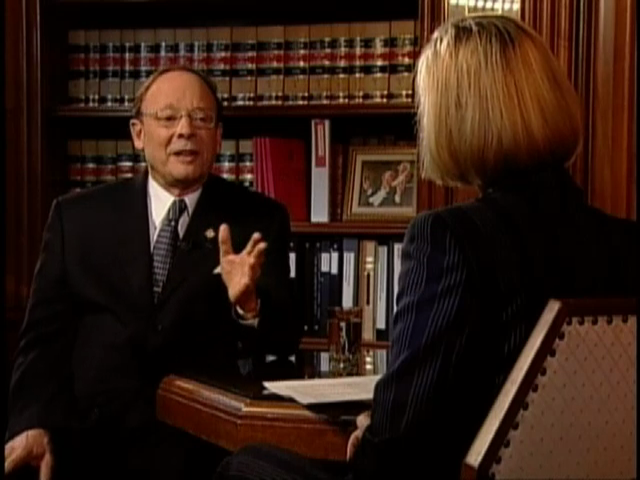
Host Tasha Kheiriddin is joined by Supreme Court Justice Charles Gonthier, who discusses the role of the Canadian Charter of Rights and Freedoms in broadening the scope of the law, the difficulty in distinguishing between the law and morality, and the appointment of Canada’s Supreme Court judges by the prime minister.
Bill C-24 / Figueroa v. Canada
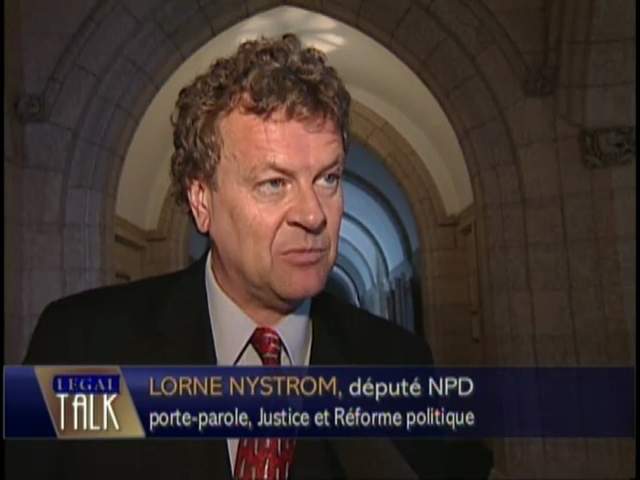
Host Tasha Kheiriddin examines Bill C-24, legislation to amend election financing provisions in the Canada Elections Act. Tasha speaks with Don Boudria (Liberal MP and government House leader), Chuck Strahl (Canadian Alliance MP), Bruce Winchester (research director for the Canadian Taxpayers’ Federation), Aaron Friedman (a Democracy Watch board member), and Lorne Nystrom (NDP MP for Regina–Qu’Appelle), who share their views on Bill C-24. Errol Mendes (law professor at the University of Ottawa) joins Tasha in the studio to discuss the legislation. On the second half of the program, Tasha speaks with Miguel Figueroa (leader of the Communist Party of Canada) and Peter Rosenthal (lawyer for Miguel Figueroa) about the Supreme Court of Canada case Figueroa v. Canada. Mr. Figueroa is challenging the requirement under the Canada Elections Act that a political party must field at least 50 candidates in a general election or risk being de-registered, among other penalties. Tasha also speaks with Roslyn J. Levine (lawyer for the Attorney General of Canada) about the so-called fifty-candidate rule. Professor Joseph Magnet (University of Ottawa) discusses the Figueroa case with Tasha.
Marijuana Decriminalization / Internet Law
Host Tasha Kheiriddin is joined by Eugene Oscapella (a founding member of the Canadian Foundation for Drug Policy) and David Griffin (CEO of the Canadian Police Association), who discuss Canada’s marijuana laws. Excerpts are shown of marijuana activist David Malmo-Levine, Prime Minister Jean Chrétien, NDP social policy critic Libby Davies, and Canadian Alliance justice critic Randy White commenting on the decriminalization of marijuana. Later, Tasha speaks with internet legal expert Michael Geist about “cyber law.” Mr. Geist explains some of the challenges for lawmakers, who must track changing technology, internet regulation, and legislation.
SARS / Entertainment Law
Host Tasha Kheiriddin is joined by Logan Atkinson (a legal historian at Carleton University), Rob Merrifield (the Canadian Alliance health critic), and Pranlal Manga (a bioethicist at the University of Ottawa), who discuss the Canadian government’s reaction to an outbreak of severe acute respiratory syndrome (SARS) and the legal responsibilities related to SARS. Later, Tasha explores the field of sports and entertainment law. She speaks with Michael Levine, an arts and entertainment lawyer. Music lawyers Paul Sanderson and Chris Taylor discuss how their own musical experience has helped their legal careers. Robin Brudner and Gord Kirke discuss their work in the field of sports law.
Anti-Terrorist Legislation, Immigrants, and Refugees Post-9/11
Tasha Kheiriddin speaks with authors Irwin Cotler and Errol Mendes about the book “Between Crime and War: Terrorism, Democracy and the Constitution,” which analyzes the negative effects of Bill C-36, the Anti-Terrorism Act, on human rights, immigration, and travel. Denis Coderre (Minister of Citizenship and Immigration) speaks with Tasha about provisions in the Immigration and Refugee Protection Act. NDP leader Jack Layton, Janet Dench (the executive director of the Canadian Council for Refugees), David Matas (immigration lawyer), Krista Daley (senior legal counsel, Immigration and Refugee Board), and Diane Ablonczy (Canadian Alliance immigration critic) speak about the potential effects of the Anti-Terrorism Act and the Immigration and Refugee Protection Act on Canada’s reputation as a safe haven for the persecuted.
Issues of Aboriginal Law
Host Tasha Kheiriddin examines the case of Treaty 8, which concerns tax exemptions for Aboriginal Canadians. She speaks with Gordon Benoit (the plaintiff in Benoit v. the Queen), Joseph Magnet (a law professor at the University of Ottawa), and John Carpay (the Alberta director of the Canadian Taxpayers Federation). On the second half of the program, Tasha looks at the obligation of companies to consult with First Nations communities on resource development projects. She speaks with Brad Morse (a professor of Aboriginal law at the University of Ottawa), Anne Giandini (counsel for the Weyerhaeuser Corporation), Terri-Lynn Williams-Davidson (the founder of project E.A.G.L.E), and John Reynolds (the government House leader for the Canadian Alliance).
Lawyers Helping the Homeless / Social Host Liability
Host Tasha Kheriddin profiles two initiatives in which lawyers help the less fortunate. John McMillan (lawyer and photographer for the “Legal Exposure” photo exhibit), Avery Teplitsky (co-ordinator for Lawyers Feed the Hungry program), and Blair Walker (a lawyer and volunteer) discuss the Lawyers Feed the Hungry program. Yukimi Henry (staff lawyer for Outreach Legal Services), Jeannie Loughrey (a priest and the acting director of All Saints Church), and Ion Radu (a client) discuss the legal services offered for free to the homeless as part of Outreach Legal Services. Later, Tasha explores the issue of impaired driving and social host liability. She speaks with alcohol liability expert Shelley Timms, Bob Solomon (the director of Legal Policy for MADD Canada), criminal defence lawyer Alan Gold, and Barry Laushway (the lawyer for Zoe Childs).
Kirk Makin / Treaty 8
Host Tasha Kheiriddin looks at journalism, television and the law with guest Kirk Makin, legal affairs journalist for the Globe and Mail and host of the History Channel’s “History’s Courtroom.” In the first of a two-part series on Aboriginal law, Tasha looks at the Treaty 8 case concerning tax exemptions for Aboriginal Canadians. Gordon Benoit (plaintiff in Benoit vs. the Queen), John Carpay (Alberta director of Canadian Taxpayers Federation), and Joseph Magnet (Faculty of Law, University of Ottawa) are also featured.
Blind Justice / Separation Agreements
Host Tasha Kheiriddin examines visual impairment in the legal profession. Along with visually impaired lawyers Yvonne Peters, David Lepofsky, and Terry Green, Tasha discusses equality rights for persons with disabilities and technological advancements for the visually impaired. Mr. Lepofsky also discusses the mandate of the Canadian Association of Visually Impaired Lawyers (CAVIL). James Chadwick and John Laskin, justices of the Ontario Superior Court, offer their own perspectives. On the second half of the program, Tasha looks at separation agreements and spousal support. Philip Epstein (lawyer for Linda Miglin), Nicole Tellier (lawyer for Eric Miglin), Peggy Malpass (a family lawyer and professor), and Senator Anne Cools discuss the Supreme Court case of Miglin v. Miglin. At issue in the case is the question of when a separation agreement becomes final.
Women and the Law / Thomas Berger
Host Tasha Kheriddin speaks with Susan Black, the vice-president of Catalyst, about a study on the challenges faced by women in the legal profession. Tasha then speaks with a number of women about the issue. Joan Brockman, author of “Gender in the Legal Profession,” discusses the difficulties of maintaining a balance between professional and private life. Mary Louise Dickson, Shereen Langdon, and Kimberly Whaley, lawyers at an all-female law firm, explain their firm’s success. Later on the program, Tasha speaks to lawyer and author Thomas Berger about his careers and the publication of his memoirs, entitled “One Man’s Justice.”
Riverkeepers / Janet Hiebert
Host Tasha Kheiriddin speaks with Mark Mattson, Lake Ontario Riverkeeper and environmental lawyer. Mr. Mattson describes his work assisting with the local enforcement of environmental laws. Lynda Lukasik, an advocate for the preservation of the Red Hill Valley in Hamilton, Ontario, describes her successful prosecution against the City of Hamilton. Ontario environment ministry supervisor Wally Rozenberg explains how the district office handles complaints. Later, author and political scientist Janet Hiebert discusses her book “Charter Conflicts.” She is joined by Senator Gerald Beaudoin, Hugh Segal (president of the Institute for Research and Public Policy), and former NDP leader Ed Broadbent. Together, they discuss the powers allocated to the courts and Parliament under the Canadian Charter of Rights and Freedoms.
The Oncomouse / Law School Tuition
Host Tasha Kheiriddin discusses details of the Supreme Court of Canada’s decision to refuse a patent application by Harvard University for the so-called Oncomouse. The court ruled that Canada’s Patent Act does not apply to higher life forms. Jo Dufay (Greenpeace Canada), Daniel Gervais ( a law professor at the University of Ottawa), Bruce Clemenger (the director of the Evangelical Fellowship of Canada), Rick Smith (the national director of the International Fund for Animal Welfare), Randall Marusyk (an intellectual property lawyer), and Industry Minister Allan Rock comment on the ruling. In the second half of the program, Tasha discusses the rising tuition costs at the University of Toronto. She speaks with Shirley Neuman (the University of Toronto provost), Neena Gupta (the chair of the Canadian Bar Association committee on equality), Sheena Scott (the director of legal services at the African Canadian Legal Clinic), Paul Riley (the president of the Osgoode Hall Students’ Association), lawyer Greg Goulin, and John McEvoy of the Canadian Association of Law Teachers.
The International Criminal Court / Figueroa v. Canada
Host Tasha Kheiriddin examines the International Criminal Court (ICC) and speaks with Errol Mendes (law professor at the University of Ottawa), Louise Arbour (Justice of the Supreme Court of Canada), William Schabas (director of the Irish Centre for Human Rights), Armand De Mestral (law professor at McGill University), David Paciocco (law professor at the University of Ottawa), John Robson (columnist for the Ottawa Citizen), and Payam Akhavan (Yale University). Tasha’s interviewees share their views on the creation and effectiveness of the court and discuss some of its potential challenges. On the second half of the program, Tasha speaks with Miguel Figueroa, the leader of the Communist Party of Canada, and his lawyer, Peter Rosenthal, about the Supreme Court of Canada’s hearing of the case Figueroa v. Canada. Mr. Figueroa is challenging the requirement under the Canada Elections Act that a political party must field at least fifty candidates in a general election or risk being de-registered. Tasha also speaks with Roslyn J. Levine, a lawyer for the Attorney General of Canada, about the so-called fifty-candidate rule. Professor Joseph Magnet, a law professor at the University of Ottawa, also discusses the Figueroa case with Tasha.
Major Court Decisions of 2001–2002
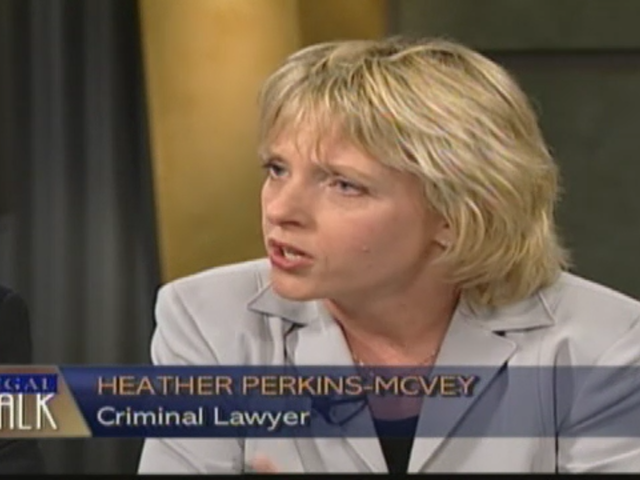
Host Tasha Kheiriddin moderates a panel discussion on the major Canadian court decisions from 2001–2002. She is joined by Heather Perkins-McVey (the chair of the criminal law section of the Canadian Bar Association), Joseph Magnet (a Univeristy of Ottawa consitutional law professor), and Eugene Meehan (a lawyer with Lang Michener). The panel discusses the issues of race and child custody (Kimberly van de Perre v. Theodore Edwards, et al.), the deportation of refugees to countries where they can face torture (Suresh v. Canada and Ahani v. Canada), the possibility that child pornography can be constitutionally protected as a form of freedom of expression (The Queen v. Robin Sharpe), and the taxation of Treaty 8 First Nations in Alberta.
Divorce
Host Tasha Kheiriddin examines divorce and the treatment of fathers during divorce proceedings. Edward Kruk speaks about shared parenting along with Gilbert Claes, Anne-France Goldwater (family lawyer), Roger Gallaway (member of Parliament and co-chair of the Joint Committee on Child Custody), Andrée Coté (director of legislation and law reform, National Association of Women and the Law), Susan Arlitt (family lawyer), Michelle Giroux (professor of Family Law, University of Ottawa), Minister of Justice Martin Cauchon, Senator Anne Cools, and Michael A. Laberge (president, Families for Accountability, Integrity and Responsibility). The second half of the program looks at collaborative family law and the “friendly divorce.” Tasha speaks with Nigel McLeod (president of the Collaborative Family Law Network of Ottawa) and collaborative family attorneys Ken Naftil and Heidi Ruppert.
Wills / Pro-Bono Legal Services
Host Tasha Kheiriddin discusses wills and estates and pro-bono work. Paul A. Dancause (a lawyer specializing in wills and estates) explains the importance of having a will, types of wills, and the need for expert advice. Charlotte Ensminger (program co-ordinator for the 2001 Pro Bono Forum), Carman Overholt (president of the Canadian Bar Association of British Columbia), John Pavey (director of the Salvation Army Pro Bono Program), Pam Shine (national director for Pro Bono Students Canada), and Esther F. Lardent (president of the Pro Bono Institute at Georgetown University) discuss their efforts to improve free legal services and access to justice.
Divorce / Modern Families
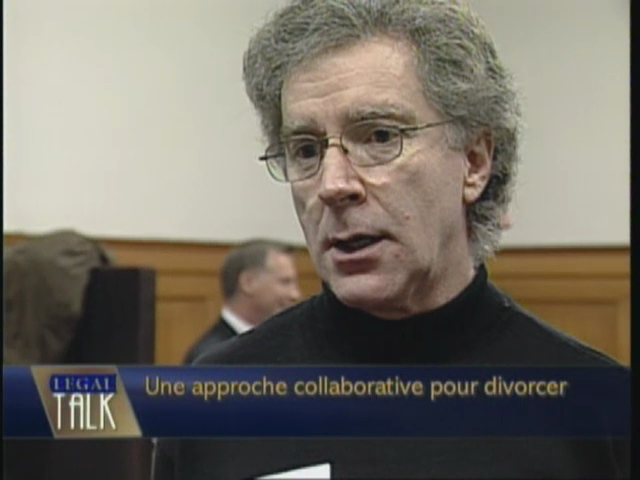
Host Tasha Kheiriddin discusses collaborative approaches to divorce, speaking with Nigel Macleod (president of the Collaborative Law Network of Ottawa) and collaborative law attorneys Ken Naftel and Heidi Ruppert. Later, Tasha reports on the legal changes required to protect rights related to different kinds of family structures. She speaks with Nathalie Des Rosiers (president of the Law Commission of Canada), Janet Buckingham (general legal counsel for the Evangelical Fellowship of Canada), Derek Rogusky (director of research for Focus on the Family Canada), John Fisher (executive director of Equality for Gays and Lesbians Everywhere (EGALE)), and Nicole Laviolette (a law professor at the University of Ottawa).
More items available